Korea* is the only divided country in the world. The polarizing 148-mile line crosses the 38th Parallel and is considered the most heavily fortified border on the planet. There is an unnerving silence that hovers over the 2.5 miles of cease-fire territory known as the DMZ (demilitarized zone), while armed guards of opposing governments stand within feet of one another, neither crossing the cement demarcation line. The Korean War is still, technically, a war. An armistice established in 1953 ushered in the last 50+ years of more silent aggression, most currently utilizing technological warfare.
Venturing closer to the DMZ, there are echoes from the past that still claim rightful ownership of modern fears: anti-tank obstacles line roads that are considered arteries to and from the borders and are designed to explode into debris to block incoming tanks; barbed wire and posts sheltering conscripts with binoculars dot the banks of the Han River; motion-detecting flood lights rise tall above the water's edge, poised to illuminate anything that trips the sensors; four secret tunnels discovered between 1974-1990 by the South are believed to have been dug by the North as infiltration measures capable of moving up to 30,000 soldiers each...in under an hour. One of the tunnels is now available as a tour elective, though I'm pretty sure you don't get a chance to purchase a photo at the end of the ride.
There are two military checkpoints required for all tours. One is just past the Han River; the other is located within the first gate of Camp Bonifas, the UN military base. At Camp Bonifas, tours must deboard from commercial buses and reboard on a military bus driven by an armed soldier. From that point forward, the military makes all decisions, including when and where cameras may be used. Photos are allowed only at certain junctures, and visitors are strongly warned against gesturing, pointing or making any sort of movement which might provoke the DPRK soldiers that are watching from all angles on the other side of the border. No one is allowed off the bus at unsanctioned stops. The area is peppered by landmines and any deviation from the route is a death wish. The only benefit to such restrictive surroundings is the freedom now available to wildlife. Within the overgrown ruins and hidden detonators of the DMZ, endangered plant and animal species have thrived, making a slight mockery of the intentions of both sides.
The apex of the tour is stepping into Panmunjeon, one of three neutral buildings where negotiations are made between North and South. Its small size is compensated by bright blue paint. One half is occupied by the North and one half by the South. There is an understanding that whenever one country has tourists inside the building, military from the other side patrol the outer half with freedom to through the windows. That didn't mean much to me until one moment in which I was taking a picture of a stoic UN soldier inside the building. As I brought the camera away from my face, I glanced up to see a pair of North Korean eyes fastened on me from outside the window five feet away. Neither of us gave way to expression. It seemed as though we were both ghosts for a moment. His gaze left me and settled on someone else, but I stood there for a few seconds taking in the sharp angles of his face and how they matched the equally sharp angles of his muted green suit, polished medals and hat. Those from the North who are stationed at the DMZ are surely some of the most brawny and well-fed in a country suffering from mass starvation; likewise, the South also selects physically superior soldiers who meet or exceed the required 5'8" stature (American counterparts must stand a little taller - six feet, minimum.). A black belt in martial arts is also requisite. Adding to the intimidation tactic is the staple pair of black opaque aviators given to each South Korean lookout. Those along the border stand at attention with clenched fists. I have no idea how long the rotation lasts, but it must be exhausting to maintain such a posture for hours at a time. Those guys might celebrate more than anyone if and when the war finally comes to an end.
*Image source:
http://www.cnn.com/WORLD/9803/13/nkorea.mobilize/map.html
From our tour bus, we began to see the increased military presence as we traveled closer to the border.
lookouts along the Han River
a memorial erected in the peace park located on the South Korean side; used by families to remember loved ones whose graves are across the border
messages for peace and unification
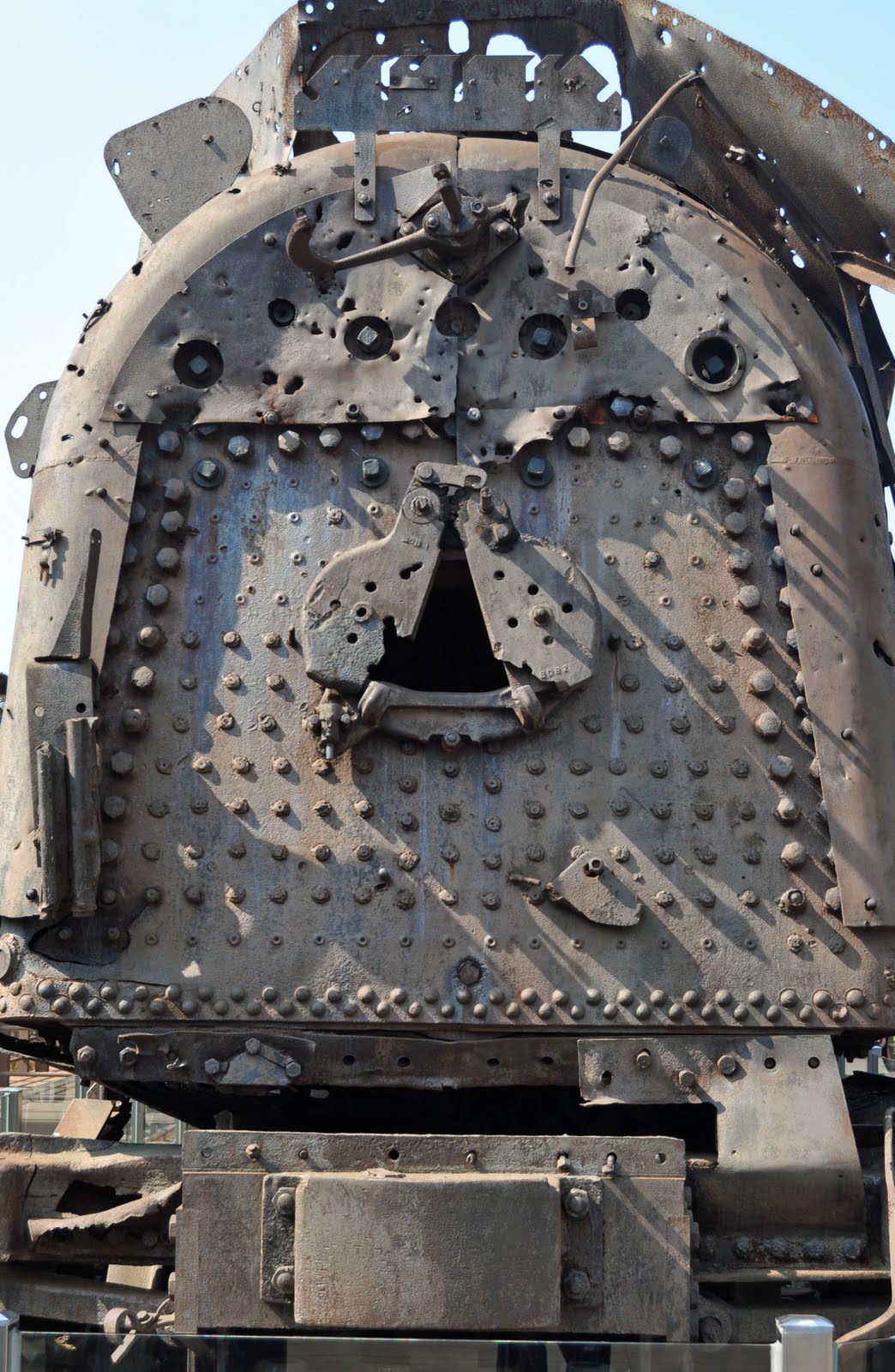
Caught in an ambush during the Korean War, this locomotive was riddled with over 1000 shells. Only the conductor survived.
These four statues represent the generations of South Koreans looking toward the North, waiting for unification.
Panmunjeon. The leftmost blue building is where negotiations are held. The large building on the opposite side is Panmungak, belonging to North Korea.
The red arrow in this photo points to the military demarcation line that divides the two countries.
Inside Panmunjeon, we were guarded by South Korean and U.S. military, representing the U.N.
a DPRK guard
DPRK guards marching
a UN soldier guarding the door that opens to the North
THE AXE MURDER INCIDENT: This plaque stands in place of a former poplar tree that was cut down in 1976. The tree became an obstruction to a checkpoint on the Southern side, so guards were ordered to prune it. In the process, they were confronted by opposing soldiers and a battle ensued. Two Americans were killed in the skirmish, including Captain Arthur Bonifas (after whom the base is named). The tree was felled three days later and replaced by a memorial. Since that time, the military demarcation line has been strictly enforced, with only the blue buildings within the Joint Security Area (JSA) being allowed any exception.
The Bridge of No Return was used primarily to exchange POWs at the "end" of the Korean War in 1953. Each prisoner was given a choice between the two countries, but once the choice was made, there was no going back. In the end, 13,444 chose to return to the North and 89,493 chose to return to the South.